
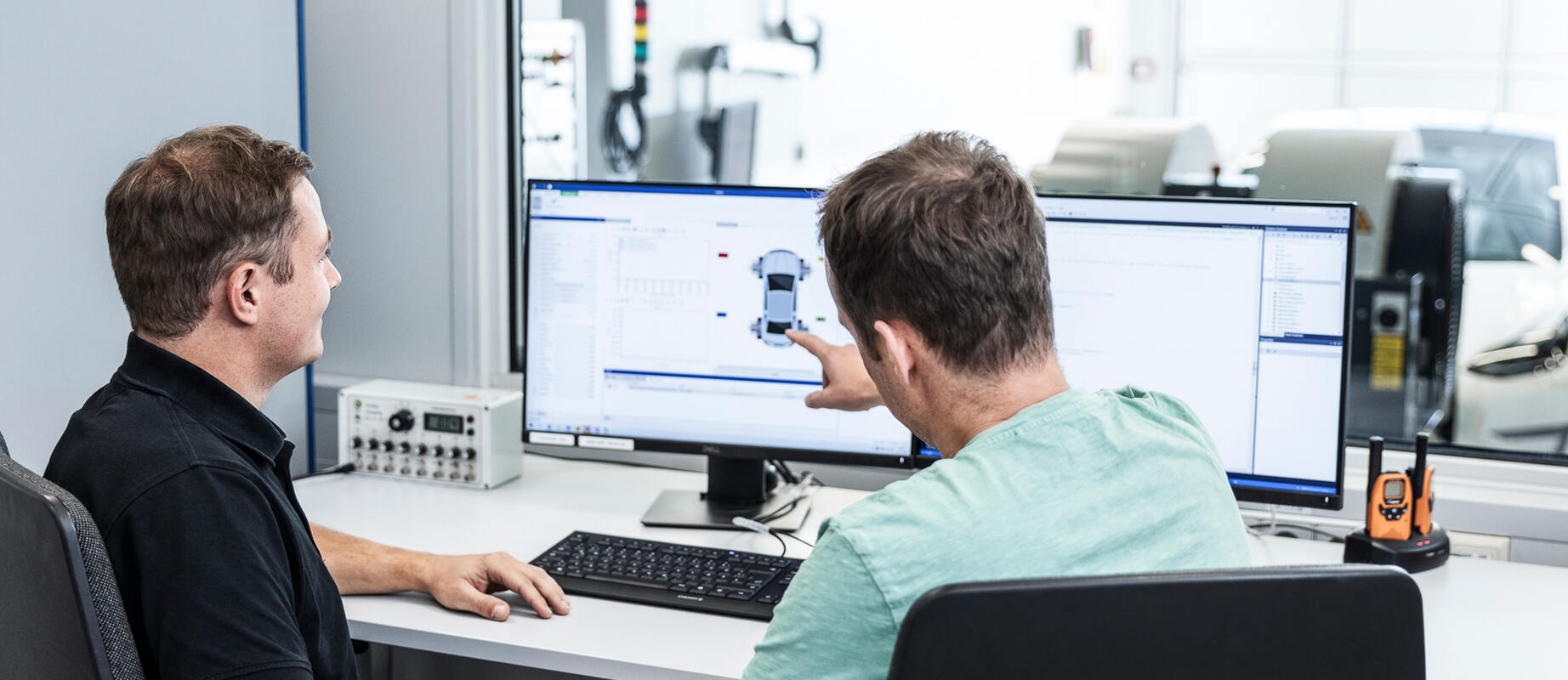
All testing processes. One software package. Maximum control.
The AIP Master Control System takes test bench automation to a whole new level.
It is your new, centralized control system: AIP's Master Control System (MCS) connects test benches and test fields in a single platform. Thanks to its open architecture and plug-in interfaces, modules and additional systems can be easily integrated at any time – MCS grows with your requirements without the need to adapt the core software. The intuitive user interface makes operation fast, safe, and efficient. All measured values, statuses, and test sequences are clearly visualized, centrally controlled, and analyzed. MCS combines functions that would otherwise be distributed across multiple systems into a single solution. This saves you time, reduces interface problems, and ensures consistent, reproducible processes – for maximum efficiency, precision, and flexibility in your test environment.
Advantages
- Thanks to 100% in-house development, AIP offers full control over functions, quality, and further development.
- The modular structure with application plug-ins enables maximum flexibility and easy expandability.
- Modern interfaces such as EtherCAT, ProfiNet, CAN, and many more ensure maximum compatibility and future-proofing.
- The system is already being used successfully by numerous customers, offering strong practical testing and references.
- As a holistic automation platform, AIP provides MCS software, RTCU real-time architecture, and applications from a single source.
Application
- Powertrain development – Automated and standardized development tests.
- Endurance testing, COP, ISC – Reliable control and monitoring of long-term tests.
- ADAS – Synchronization of scenarios, sensors, and test bench.
- Aerodynamics – Reproducible test conditions through precise process control.
- Battery testing – Automated profiles, data logging, and safety functions.
- EMC – Coordinated test sequences, device connection, and logging.
- FuelCell – Controlled operating conditions, load profiles, and safety.
- NVH and acoustics – Synchronized excitation and measurement data acquisition.
- End-of-Line – Fast test cycles with automatic evaluation and traceability.
The AIP Master Control System takes over.

Specifically developed for the test bench
The MCS is developed and maintained entirely in-house by AIP. This independence ensures that all functions, interfaces, and architectures are consistently coordinated. Adjustments can be implemented without external dependencies, enabling precise control over software quality, system behavior, and long-term further development. This keeps the platform technically consistent and expandable at any time.

Modular structure
The MCS is based on a modular architecture that can be flexibly expanded using application plug-ins.
Individual function modules can be added or replaced without restructuring the entire system. This allows for a clear separation of basic functions and application-specific extensions. Modularity reduces integration effort, facilitates maintenance, and supports systematic scaling – from small control units to complex systems.
Individual function modules can be added or replaced without restructuring the entire system. This allows for a clear separation of basic functions and application-specific extensions. Modularity reduces integration effort, facilitates maintenance, and supports systematic scaling – from small control units to complex systems.
Technological diversity
The platform supports numerous established industry protocols such as EtherCAT, ProfiNet, CAN, OPC-UA, AK, and FDX.
This broad interface coverage allows the system to be integrated into a wide variety of plant environments. The use of standardized communication protocols enables reliable data transmission, easy coupling to third-party systems, and a high degree of future-proofing. New interfaces can be added cleanly if required.
This broad interface coverage allows the system to be integrated into a wide variety of plant environments. The use of standardized communication protocols enables reliable data transmission, easy coupling to third-party systems, and a high degree of future-proofing. New interfaces can be added cleanly if required.

Practical application
The MCS is used productively by various customers and has proven itself in a wide range of applications.
The existing installations serve as proof of stability, robustness, and reliable runtime behavior. Feedback from real-world applications is continuously incorporated into further development, ensuring that the system is further optimized under practical conditions. As a result, the platform grows in a targeted and experience-based manner.
The existing installations serve as proof of stability, robustness, and reliable runtime behavior. Feedback from real-world applications is continuously incorporated into further development, ensuring that the system is further optimized under practical conditions. As a result, the platform grows in a targeted and experience-based manner.

Integrated platform
As a closed automation platform, MCS combines software components with real-time architecture and application-specific extensions.
All elements are technically coordinated and follow a common system logic. This reduces project planning complexity, simplifies error analysis, and ensures consistent system behavior. The result is a stable basis for a wide range of automation tasks – without heterogeneous system landscapes.
All elements are technically coordinated and follow a common system logic. This reduces project planning complexity, simplifies error analysis, and ensures consistent system behavior. The result is a stable basis for a wide range of automation tasks – without heterogeneous system landscapes.