
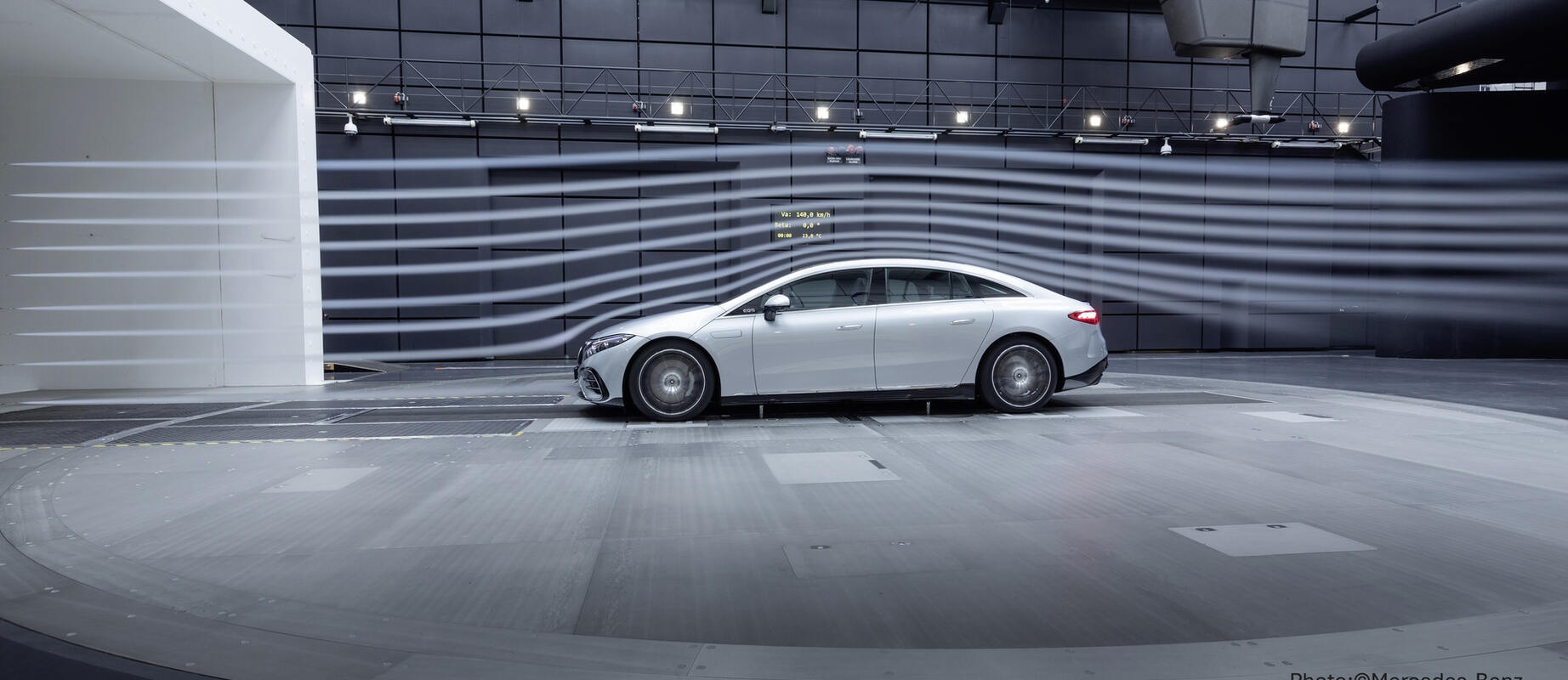
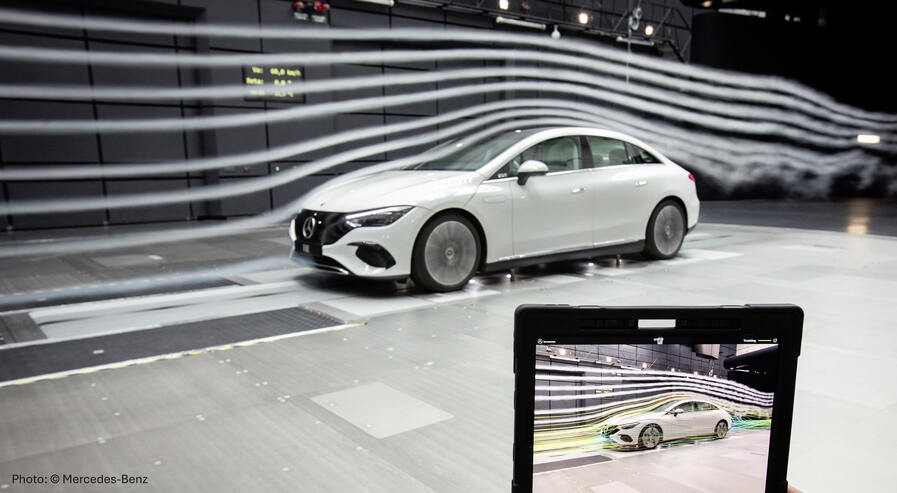
Take advantage of headwinds.
The AIP six-component wind tunnel balance is the precise heart of aerodynamic measurements. It reliably records longitudinal force, lateral force, and lift, as well as all three moments – the basis for a comprehensive evaluation of aerodynamics, driving stability, and flow behavior.
This is made possible by a highly rigid, low-vibration measuring platform equipped with six precise force and moment sensors that reliably map even the smallest aerodynamic changes. The integrated calibration unit with electrically driven weights enables regular, reproducible checking of the measuring elements, while a QuickCheck system ensures a quick function check before each test run.
The AIP wind tunnel balance thus delivers exactly the data that modern vehicle development requires: reliable measurements for optimizing drag, lift, crosswind stability, and aerodynamic balance. Whether validating CFD simulations, evaluating design variants, or developing new vehicle platforms, the AIP wind tunnel balance provides the basis for reliable, efficient, and practical aerodynamic development.
Advantages
- Highest measurement precision: Precise recording of all six forces and moments for the finest aerodynamic detail analysis.
- Reproducible calibration: Integrated calibration unit and QuickCheck ensure reliable measurement accuracy at all times.
- Universally applicable: Suitable for a wide variety of vehicle types and components – from aerodynamics to stability.
- Robust and maintenance-friendly: Durable construction for reliable continuous operation and fast service procedures.
- Sound basis for decision-making: Precise measurement data for optimizing aerodynamics, handling, and design variants.
Application
- Aerodynamic optimization: Measurement of drag, lift, lateral force, and moments to increase efficiency and performance.
- Crosswind & stability: Evaluation of response to crosswinds to improve safety and directional stability.
- Design and geometry comparison: Analysis of different body and component shapes for their aerodynamic influence.
- CFD validation: Real measurement data for validation and calibration of flow simulations.
- Component testing: Precise measurement of aerodynamic effects of individual components.
- Vehicle platform development: Evaluation of aerodynamic properties of prototypes and concept vehicles.
The wind tunnel balance – one gust ahead
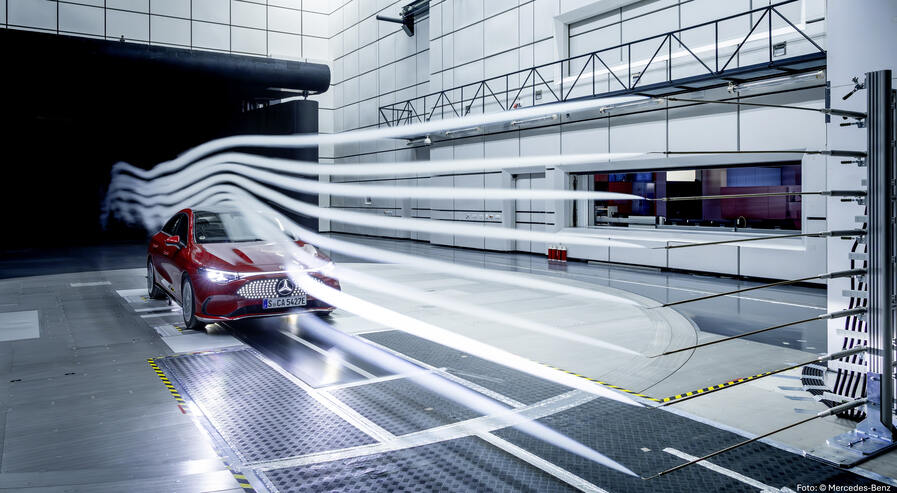
Precise six-component measurement
The wind tunnel balance records all three forces (Fx, Fy, Fz) and three moments (Mx, My, Mz) with high resolution and low measurement noise. The sensors are arranged in such a way that cross-sensitivities are minimized and load paths are clearly separated, allowing even complex aerodynamic load conditions to be reconstructed cleanly.

Highly rigid measuring platform
The platform consists of an FEM-optimized structure with high bending stiffness and torsional stability. This shifts natural frequencies to ranges outside the typical flow and tunnel excitations, making the measurements largely insensitive to vibrations, pulsations, and mechanical disturbances.
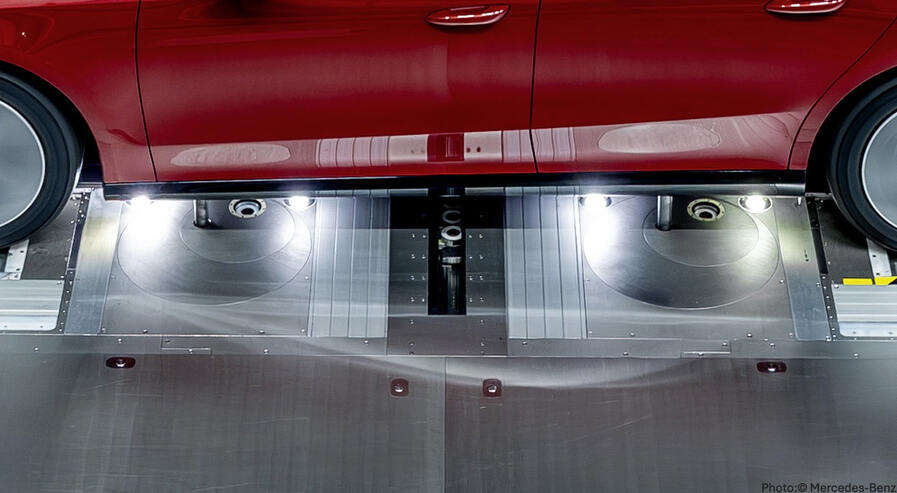
Integrated calibration unit with functional test
The calibration unit generates defined loads using electrically movable weights, which allow reproducible force and torque inputs according to standard predefined load paths. This allows the entire measuring chain to be regularly checked, linearized, and documented – without disassembly or external auxiliary systems. Before each test run, the integrated QuickCheck system validates the basic function of all sensors and measurement paths by means of short self-tests and detects deviations at an early stage.

Ideal for vehicle and component development
The balance supports testing of complete vehicles, models, and individual components thanks to its high maximum permissible load and precise recording of dynamic load changes. This makes it suitable for cw optimizations, balance investigations, component comparisons, and aerodynamic function analyses throughout the entire development process.
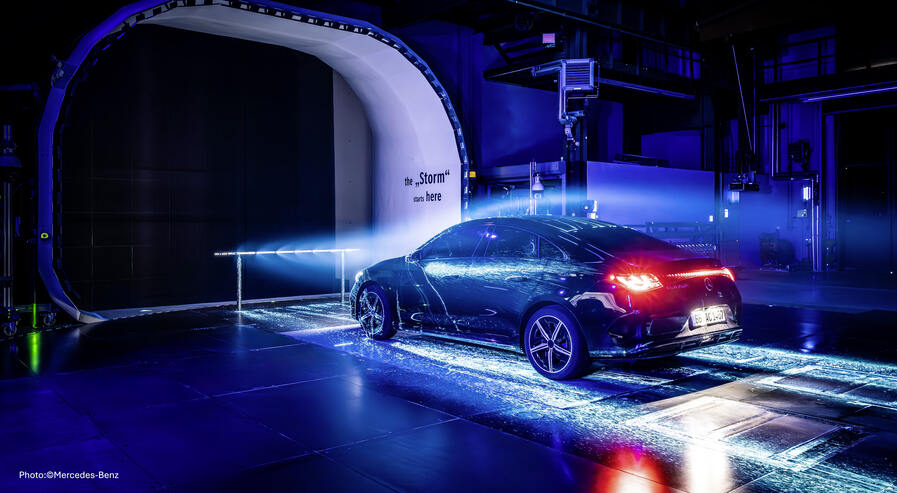
Precise decision-making data for aerodynamics
The balance provides reliable data on air resistance, lift, lateral force, and aerodynamic moments, which are directly incorporated into the evaluation of a vehicle's stability, efficiency, and overall performance. This enables a clear assessment of design variants and their influence on balance and handling.
Support for data-driven development processes
Thanks to its high measurement accuracy, the wind tunnel balance serves as a reliable reference for computational fluid dynamics (CFD) simulations, enabling digital models to be validated and optimized. The precise load data supports modern, simulation-driven development approaches such as virtual aerodynamics, sensitivity analyses, and digital twins.