
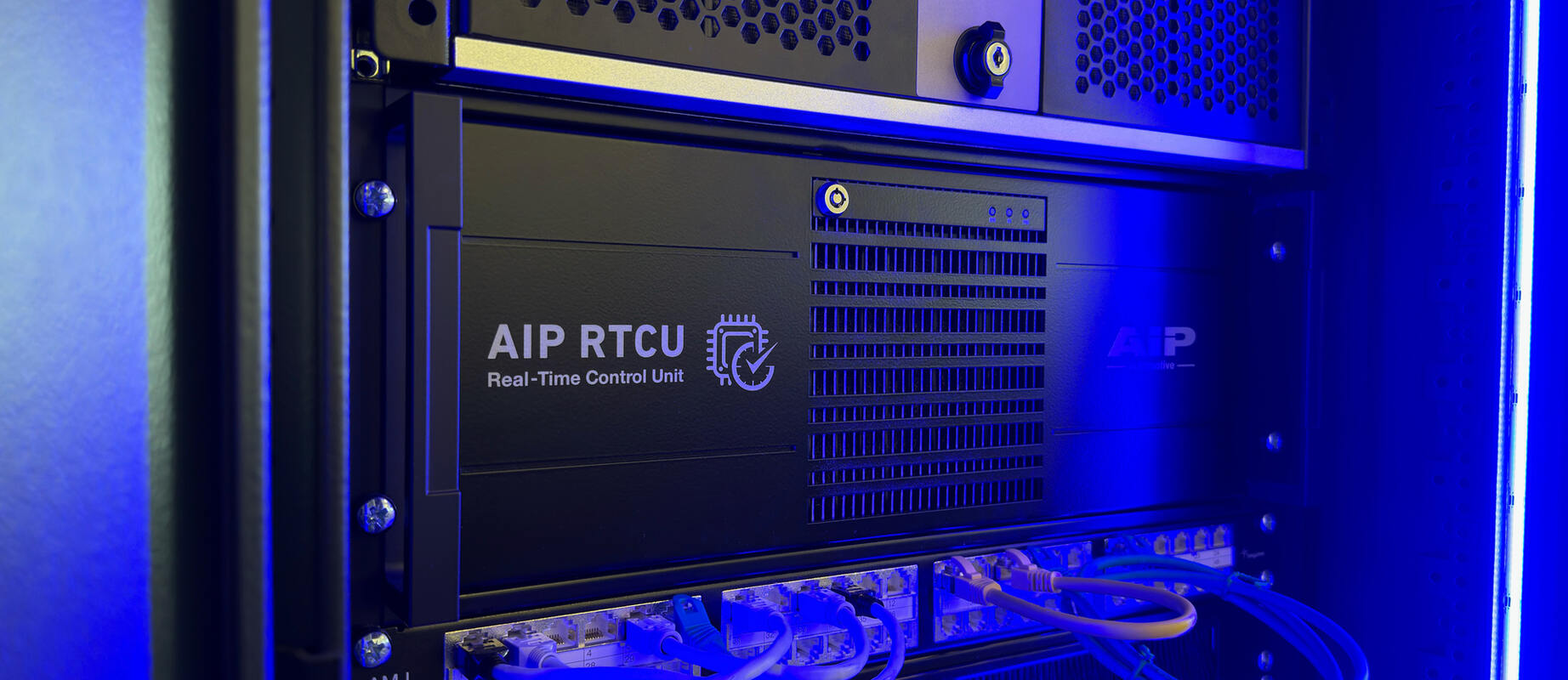
Everything always under control.
The AIP RTCU real-time system is a powerful, modular control and regulation unit for highly dynamic automation applications. It is based on a compact IPC with high computing power, real-time capability, and modular expandability. This enables the RTCU to provide deterministic control with minimal latency and ensures precise and reproducible processes even in dynamic processes. Seamless integration into the AIP automation platform allows control, monitoring, and process automation to be efficiently combined. The solution is also scalable – from compact machines to complex plant structures – and adapts flexibly to the respective requirements.
Highlights at a glance
- Real-time capable up to 10 kHz – for precise, synchronous processes
- MATLAB Simulink integration – execute models directly in real time
- Graphical sequencer – intuitive process control without programming effort
- Maximum connectivity – EtherCAT, CAN, PROFINET, Modbus, and much more
- Robust hardware – compact IPCs for continuous operation under industrial conditions
- AIP Toolbox – flexible real-time functions for individual requirements
Technical features
- Real-time operating system for deterministic control
- Up to 6 EtherCAT masters for modular extensions
- UPS module for data security in the event of a power failure
- Support for all common DAQ systems and rest bus simulations
More speed. More precision. More interfaces. – the AIP RTCU

MATLAB Simulink model integration
These can be transferred directly to the control system and executed there in real time with a processing cycle time of up to 10 kHz. This allows model-based control and simulation-supported process control to be implemented seamlessly and with high performance.
Real-time sequencer
The sequencer developed by AIP is the heart of the graphically programmable sequence control and is fully integrated into the RTCU. It enables real-time execution of complex test sequences directly at the control level and is centrally configured and monitored via the MCS software. The intuitive, graphical user interface allows for easy creation, customization, and online monitoring of sequences – without the need for in-depth programming knowledge. The sequencer also offers extensive diagnostic and logging functions that enable transparent process control and fast troubleshooting. A special highlight: sequences can be exchanged online and executed immediately without restarting the system. The blocks (functions) contained therein can be created or customized for specific projects and customers.

Interfaces
The RTCU can be seamlessly connected to the AIP automation system MCS (Master Control System). This allows all relevant functions of the real-time system to be visualized and data to be collected. AIP's innovative FastSignal technology transmits highly dynamic data streams – ideal for online oscilloscopes, live diagnostics, and precise real-time analyses.
Maximum connectivity – all important interfaces are available:
- EtherCAT
- Ethernet (TCP/IP, UDP)
- CAN, CAN-FD, CANopen
- PROFINET, PROFIBUS
- Modbus
- RS232 / RS485 serial interfaces

EtherCAT Master
The RTCU supports up to six flexible EtherCAT masters (clock rate between 1 and 10 kHz) and a free bus topology with a modular design. Expansion is possible via:
- Various standard digital and analog terminals
- Special and measurement modules, e.g., for temperature measurement, position detection, energy monitoring, IEPE signals, communication, and much more
- Various other EtherCAT participants (slaves)
AIP Toolbox
The AIP Toolbox is a comprehensive library of real-time functions developed specifically for the RTCU. It can be used dynamically and project-specifically and offers flexible tools for individual customer requirements. Core functions include:
- Scaling and filtering of channels for precise signal processing and analysis.
- Online mappings and calculations to process complex data streams directly in real time.
- Dynamic setpoint specification from files (FileStimuli).
- Real-time limit monitoring for immediate detection of limit value exceedances.
- Expandable modules that can be supplemented on a project- or customer-specific basis and integrated into existing applications.